HISTORY OF SCHOOL OF NURSING,
ST. LUKE'S HOSPITAL TINSUKIA
HISTORY OF SCHOOL OF NURSING, ST. LUKE'S HOSPITAL TINSUKIA
INTRODUCTION
The Diocese of Assam, now known as the Diocese of the North East India, under the Church of North India (CNI), began the medical work in Upper Assam in Chabua in 1923 and after about 56 years, the medical work was extended to Tinsukia in 1979.
It will be necessary to begin with Chabua Hospital, which is the mother institution. The two hospitals are very closely connected today. Chabua is a small town, but in 1920 it was somewhat of an overgrown village. It is situated in upper Assam, mid-way between Dibrugarh and Tinsukia - Assam. In the early days it was known as "HATH KHOLA DEO DHAI". The area is rural in nature surrounded with Tea Gardens. As days went by, because of Tea the place acquired the name of Chabua, which means "Tea Planting".
THE BEGINNING OF MEDICAL WORK
Helen began her work in three ways; firstly tour the Christian centres in the area and get together the women to teach them simple medical knowledge and started Home Care Base Nursing and First Aid Training, secondly, trained mid-wifery skill to the local dias, and thirdly developed dispensary at Chabua. Then the Tea Planters approached Helen to train their dias, and she agreed to extend her time schedule. 16 women came from the tea garden for training. Later when doctors joined the hospital, the training of tea garden dias was put on business purpose and the tea garden workers had charged on per head basis.
TEETHING TROUBLES
The first ten years in the life of St. Luke's Hospital were of frustration, challenge and of hope. The first and the initial problem were to get nurses. There were none and the patients had to bring a member of their family to company them. The local girls at the Christian centres were illiterate and there was no possibility to train them due to poor education as they qualified in primary level , moreover the people had no idea of nursing profession and were least interested in it. But when people saw the work at the Hospital, candidates slowly, began to come. In 1930, two girls, one fully trained nurse came from another Mission Hospital. At this time, boys also came for training, and they were trained as orderlies. As far back as 1924, Miss Slawson had started a three week course for the candidates from Christian centres. These were chosen and supported by the villagers. The Hospital management provided them a place to stay, cooking utensils and they did their own cooking. Children over one year were not allowed with mother trainees. At the end of three weeks they were given a test. In day time they had prayers. In the first year there were eleven trainees and in the next year twelve came for the training. After the three weeks training, they were sent home and were asked to come after a year to give report, and they were given the next course of training and a refresher course. It was helpful and happy time for them. Most of them were not good in theory part, but were quite good in practical work.
THE NURSING SCHOOL
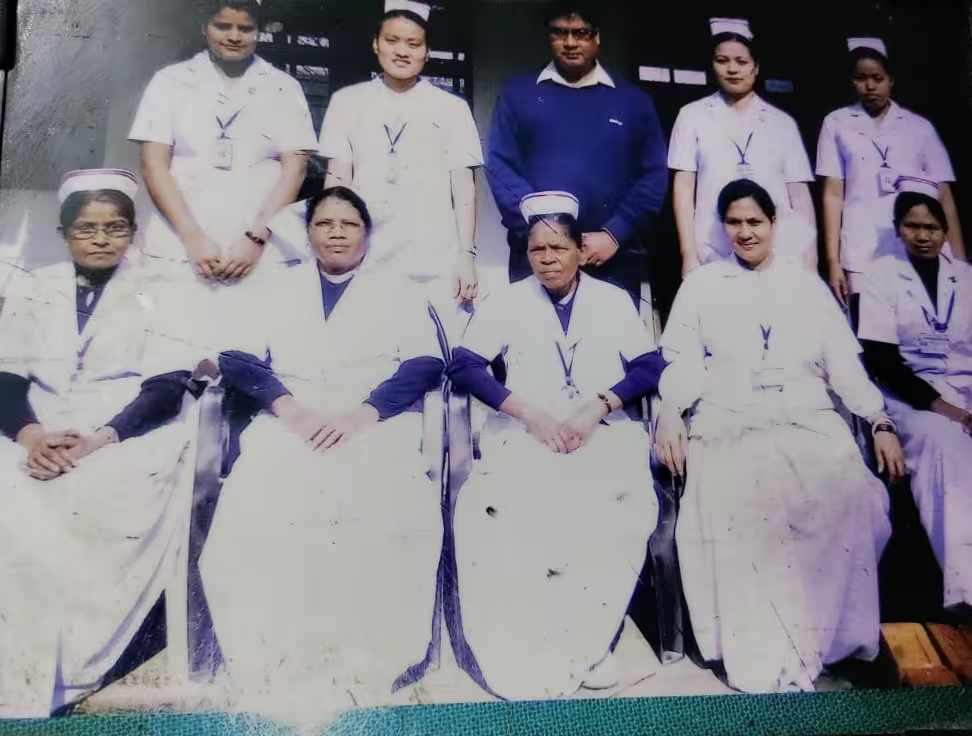
In the nineteen forties Miss. Workman was the Sister Tutor and Miss Sands was on the staff under their guidance. "The Nurses and Midwife Training School" at the hospital was recognized by the Assam Nurses & Midwives and Health Visitors Council. Miss Sands took over from Miss Workman and worked till 1965 and died on the eve of her retirement. Miss. Jenson who had joined the hospital in 1963, took over after Miss Sands. In 1966 Miss Donne was appointed Midwifery Sister Tutor. The Nursing School retained consistent good results in the State examination. Approximately 1000 trained nurses have been qualified till date from this School of Nursing and working all over the country in different settings and few are serving abroad. It shows fulfilling the aim of the school of Nursing which was "to train holistic nurses to be serve," wherever they are.